


Buddhism in the Soviet Union

Karl Marx declared religion ‘the opiate of the masses’. This single statement has served as the foundational thought regarding the Communist attitude to religion in general ever since. But exactly what this means for non-European religions has never been made clear.
Both Marx and Engels thought deeply about the influence of religion upon the working classes in Western Europe, and as a result, analysed the effects of the established Judeo-Christian religions upon the masses. The other religions of the world were virtually unknown in 19th century Europe at that time, beyond vague, obscure, and often misunderstood, fragmentary references.
As a result, ‘ALL’ religion has been defined by this initial statement of Karl Marx, by Communists ideologues who came after him, regardless of the particular religion’s place of origination, philosophy or distinctive history. Religion, itself, is viewed as an internalisation of outer hopeless circumstance, a hopelessness that is the reality of external, oppressive, social forces, a symptom of living in a bourgeois, Capitalist society that allows for little or no freedom of expression outside of the exploitative, economic arrangement, but instead promises only a ‘daily grind’ for survival. In such circumstance, the human being experiences a need to ‘transcend’ the oppression, but instead of changing the outer circumstances, this tendency is averted away, and focused into building an inner structure of mythological escape in a distorted attempt to relieve the outer, social pressure. The source of outer suffering is never relieved, of course, and the religious attitude has to create a compensatory award system that promises ‘salvation’ in some far off time and place, but never observable in the present.
In the Judeo-Christian theistic tradition, it is the promise of heaven or the threat of hell. A central God figure dispenses arbitrary justice upon the masses, and virtue is defined as the accepting of suffering in physical life, enhanced by not changing or eradicating the source of the social suffering. For Marx, the religious attitude teaches that we should accept suffering and oppression today for a far off reward that never arrives because it does not exist. Marx likened a society in the grip of established religion as being like a drug addict viewing the world through a drug induced haze. The religious mind-set, therefore, prevented the working class from establishing a clear view of what is really going on in society. A working class with no awareness suffers from a ‘false consciousness’, and can not rise up in revolution. Therefore, Marx views religion as part and parcel of the oppressive, capitalist system which actively strives to keep the down-trodden firmly in their place.
Not all religions are theistic; that is, require an unquestioned belief in a central god concept. It is true that virtually every religion in the West is theistic, but in Soviet Russia, the philosophical path of Buddhism existed, and an attempt was made to integrate it into the Communist framework of society. Buddhism acknowledges that life is suffering, and actively strives to over-come that suffering through meditative endeavour. Lenin, the leader of the Bolshevik party (that took power in Russia in 1917 – eventually forming the Union of Soviet Socialist Republics), was of the opinion that Marx was correct, but that religion, itself, should not be oppressed or outlawed, creating a sudden, and potentially damaging, historical rift with the past. Therefore, Lenin prevented the Bolshevik party being declared officially ‘atheist’. He thought that religion was so entrenched in the suffering masses that a mere outer propaganda offensive would not get to the root of the matter. Lenin, like Marx and others, wanted to build a Socialist society through the use of scientific planning. When living standards rose to never before seen levels of affluence and compassion, heaven would have been made on earth. And as a consequence, the archaic thought structures and superstitions of theistic religion would eventually wither away. When viewed in this light, religion is an inner reaction to outer oppression, nothing more. When the outer oppression ceases, the inner religious attitude is not triggered and does not occur.

Lenin sought a natural progression over time, rather than a sudden and abrupt ending of religion in the Soviet Union. This is seen in the continued existence of the Russian Orthodox Church, and the forming of the Russian Buddhist Church, under Bolshevik rule. The Russian born Buddhist Lama, Agnav Dorzhiev, (1854-1938), worked to propagate Buddhism in Russia both under the Tsarist regime, and under the Bolsheviks. In John Snelling’s book entitled ‘Buddhism in Russia’, we learn why Dorzhiev believed Buddhism and Marxism were compatible.
Dorzhiev, himself, argued that Buddhist doctrine is largely compatible with current Communist tradition because:
That the weak should not be oppressed but cared for; that everyone should be regarded as though they were a {close} relative; that non-virtues, such as stealing, should be avoided; that the various kinds of avarice and magic should not be allowed; {and} that one should engage in a truthful and upright livelihood. He also ingeniously proposed the consonance of Buddhism with dialectical materialism on the grounds that it did not doctrinally assert the existence of God and so was a “religion of atheism”.
Despite the work of Dorzhiev and others, all religion came under suspicion in the USSR. Russia, as a country in Europe, was probably the first European country to develop Buddhist practice, particularly amongst European Russians. However, at least two national minorities – the Buryat (south central Russia), and the Kalmyks (west Russia), were descended of Mongolian stock, and practiced mainly Tibetan Buddhism. Dorzhiev, himself, a Russian born Buryat, was the tutor of the 13th Dalai Lama, and Lhasan emissary to the Tsar. He was also instrumental in the building of the Buddhist temple of St Petersburg (completed in 1915).
Stalin declared Collectivisation in 1931, and a new wave of religious persecution was begun. And this time period witnessed a new anti-Buddhist rhetoric in Communist propaganda. Stalin, (unlike Lenin), did not believe that religion would wither on the vine without actual destructive pressure from the outside. Dorzhiev, himself, like thousands of others, was arrested by Police in 1938, where it is believed he died of a heart attack. The Kalmyks of eastern Russia, were cleansed from their homeland, and banished to Siberia where many thousands died of starvation.
Buddhism has the potential to be a very progressive and supportive force in social reform and change that could benefit all beings. Buddhist meditation frees the individual from the bonds of inner tyranny. Today, multi-ethnic and multicultural Russia allows Buddhist practice. Buddhism encourages and develops a state of inner Socialism that in the right circumstances can manifest in the outer environment. It is interesting to contemplate what would have happened if the Bolsheviks had approached Buddhism in a different light, and attempted to equate Buddhist loving kindness and compassion with Communist collective sharing and progressive science - the outer freedom that the Bolsheviks promised the oppressed masses of Russia and that Karl Marx intended for the world.
by Adrian Chan-Wyles 
Source: Dissidentvoice.org

Ancient Buddha Statues and Relief pictures

Buddha Shakyamuni, India, Bihar. Pala period, late 9th–early 10th century. Schist. Asia Society, New York: Mr. and Mrs. John D. Rockefeller 3rd Collection, 1979.37. © Asia Society, New York

Pilgrimage and Buddhist Art is the first major exhibition of its kind devoted to the impact of Buddhist pilgrimage on Asia’s artistic production. It highlights approximately 120 objects of importance and extraordinary quality, including sculptures, paintings, prints, ritual implements, photographs, and maps.
The objects, dating from the first to the twentieth century, will be on loan from museums and private collections in North America, and a number of the pieces have never been displayed publicly before. Pilgrims and pilgrimage inspired centuries of artistic production and its patronage influenced the development of visual culture in Asia.

Buddhist pilgrimage began in South Asia in the first century with journeys to sites of the major events in the Buddha’s life: the places of his birth, his enlightenment, his first teaching, and his death are all pilgrimage destinations and testify to the importance of his life story.
Using exceptional and visually stunning examples, Pilgrimage and Buddhist Art explores the ways in which the act of pilgrimage influenced artistic production across Asia, considering both the necessity of art objects for particular spiritual journeys and the rise of commissions to create sacred objects, such as painted mandalas, scrolls, screens, sculptures, reliquaries, prayer wheels, traveling shrines, textiles, and maps. Examples of these objects introduce the concepts of pilgrimage motivation, ritual preparation, and movement and worship at the sacred destination, as well as highlight the regional variety of Buddhist pilgrimage practices and art production due to the influences of preexisting or coexisting religious practice.
Pilgrimage and Buddhist Art is organized by Asia Society Museum and presented in conjunction with The Buddha, a film by David Grubin for PBS. New York Premiere at the Asia Society, March 23, 2010; the film airs on PBS April 7, 2010.
The historical Buddha, often called Shakyamuni (“Sage of the Shakyas”) in later times, was born into an elite family of the Shakya clan, whose territory lay on what is now the border between northeastern India and Nepal. Traditionally, the date of his birth was believed to be 563 BCE, but he may have been born as much as a century later. After renouncing his princely life for spiritual pursuits, he began a long physical and spiritual journey that ultimately led to his enlightenment under the Bodhi Tree in Bodh Gaya. After his enlightenment, he went on to teach the Four Noble Truths. According to this doctrine, suffering exists in all life; suffering is caused by desire or attachment; to end suffering, one must transcend desire or attachment; and to transcend desire and attachment, one must follow a path of righteous living, known as the Noble Eightfold Path.
Prior to his death, the Buddha instructed his disciple Ananda that followers could continue to seek and venerate him in places that resonated with important events in his life: the sites of his birth at Lumbini, his enlightenment at Bodh Gaya, his first sermon at Sarnath, and his death at Kushinagara. Many representations of the Buddha produced across Asia reference these and other sacred sites associated with him. For example, the tenth-century stone sculpture of Shakyamuni on view in the center of this room has several elements that identify the enlightenment site at Bodh Gaya. These include the Bodhi Tree, carved here as a leafy branch, and the Buddha’s hand gesture, which signifies calling the earth to witness his right to enlightenment. Similar sculptural examples from Myanmar/Burma and Tibet attest to the wide dissemination of this imagery. Buddhists from all over the world continue to make pilgrimages to these powerful sacred sites.
A glance at the large Japanese Buddhist world map in this room shows the spread of Buddhist sites across Asia. Many of these are places where relics or purported relics of the Buddha were buried. Relics imbue sites with sacred power, and the proliferation of Buddhist relics across Asia is closely associated with the spread of pilgrimage practice. Eventually relics of other Buddhist figures, such as major teachers or those associated with important Buddhist actions or miraculous events, were also interred. These burial places either became new pilgrimage destinations or contributed to the spiritual power of existing pilgrimage sites.
March 16 – June 20, 2010
4
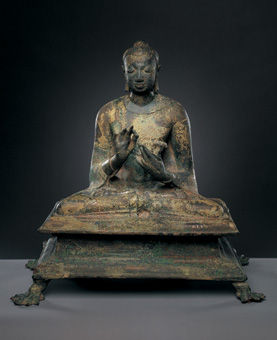
Buddha in the Gesture of Preaching. India, Gupta period, 6th century. Copper alloy with copper and silver inlay. Asia Society, New York: Mr. and Mrs. John D. Rockefeller 3rd Collection, 1979.7. © Asia Society, New York
5_Morandi_Rest_on_the_Flight_into_Egypt
Buddha Shakyamuni with Kneeling Worshippers. Myanmar/Burma, 14th - 15th century. Gilt copper alloy. Asia Society, New York: Mr. and Mrs. John D. Rockefeller 3rd Collection, 1979.91a–c. © Asia Society, New York
5
Buddha Shakyamuni, Tibet, 11th century, Copper alloy with copper overlay and inlays of silver. Asia Society, New York: Mr. and Mrs. John D. Rockefeller 3rd Collection, 1979.89 © Asia Society, New York
06_arcangelo_di_jacopo
Narrative Panels with Scenes from the Buddha's Life, Pakistan (ancient Gandhara), 2nd century. Gray schist. The Walters Art Museum, Baltimore, Maryland, Gift of John and Berthe Ford, 25.259. © The Walters Art Museum, Baltimore, Maryland
6
Buddha's First Sermon at Sarnath, Pakistan (ancient Gandhara), Kushan period, ca. 2nd century. Gray schist. The Metropolitan Museum of Art, Gift of Daniel Slott, 1980, 1980.527.4. © The Metropolitan Museum of Art
9_Habert_still_life
False Dormer Stele with Scene of Life of the Buddha, Pakistan (ancient Gandhara), Kushan period, 100–300. Schist. Asian Art Museum of San Francisco, The Avery Brundage Collection, B60S255. © Asian Art Museum Foundation, San Francisco. Used by permission
1
Portion of a Disassembled Stupa, India, Bihar, Bodh Gaya region, 9th century. Basalt. Philadelphia Museum of Art: Purchased with the George W. B. Taylor Fund, 1921, 1921-36-1. © Graydon Wood, courtesy Philadelphia Museum of Art
1
Goddess Palden Lhamo, Central Tibet, Densatil Monastery, 15th century. Gilt copper alloy, color, and semiprecious stones. Arthur M. Sackler Gallery, Smithsonian Institution, Washington, D.C.: Purchase Friends of Asian Arts in honor of the 10th Anniversary of the Arthur M. Sackler Gallery, S1997.27. © Arthur M. Sackler Gallery, Smithsonian Institution
1
Reliquary in the Shape of a Stupa (Relic Mound), Pakistan (ancient Gandhara), Kushan period, ca. 4th–5th century. Bronze. The Metropolitan Museum of Art, Gift of Mr. and Mrs. Donald J. Bruckmann, 1985, 1985.387a,b. © The Metropolitan Museum of Art
1
Stupa Reliquary, Sri Lanka, Anuradhapura period, ca. 200. Crystal and gold. The James W. and Marilynn Alsdorf Collection. © Michael Tropea
1
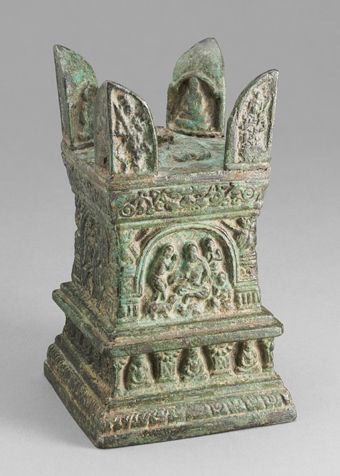
Miniature Stupa with Illustrations of Jataka Tales, China, Five Dynasties period, 955. Bronze. Harvard Art Museum, Arthur M. Sackler Museum, Gift of Nasli M. Heeramaneck, 1930.105. © Imaging Department © President and Fellows of Harvard College
1
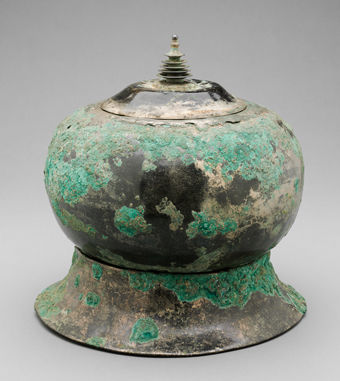
Covered Stupa-Form Buddhist Reliquary with Knob in the Shape of a Stupa Finial , Korea, Unified Silla period, 8th–9th century, Bronze. Harvard Art Museum, Arthur M. Sackler Museum, Anonymous Gift, 1944.57.29.A–C. © Imaging Department © President and Fellows of Harvard College
1
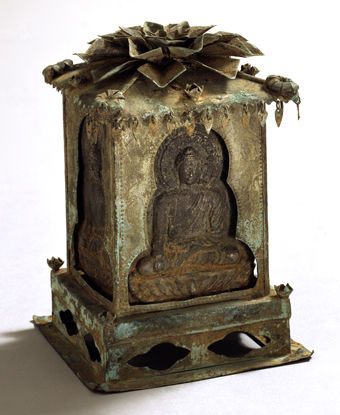
Reliquary, Korea, Unified Silla period, late 9th–early 10th century. Bronze and copper alloy. Royal Ontario Museum, Toronto, Dr. Herman Herzog Levy Bequest Fund, 992.124.1 © With permission of the Royal Ontario Museum © ROM. Photo: Brian Boyle
1
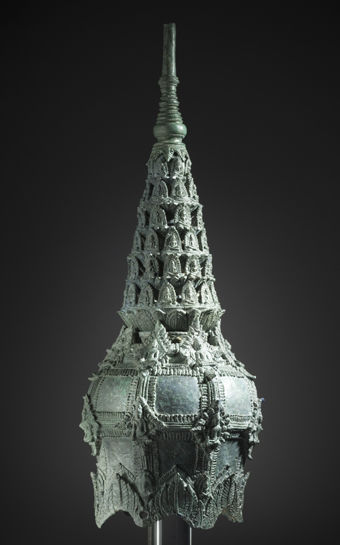
Model of a Stupa, Thailand or Cambodia, 12th–14th century. Copper alloy. Los Angeles County Museum of Art, Gift of Anna Bing Arnold, M.87.243 © 2009 Museum Associates/ Los Angeles County Museum of Art
Source: http://alaintruong.canalblog.com/tag/Korea

Speaking of the Faults of Others


"I vow not to talk about the faults of others." In the Zen tradition, this is one of the bodhisattva vows. For fully ordained monastics the same principle is expressed in the payattika vow to abandon slander. It is also contained in the Buddha's recommendation to all of us to avoid the ten destructive actions, the fifth of which is using our speech to create disharmony.
The Motivation
What an undertaking! I can't speak for you, the reader, but I find this very difficult. I have an old habit of talking about the faults of others. In fact, it's so habitual that sometimes I don't realize I've done it until afterwards.
What lies behind this tendency to put others down? One of my teachers, Geshe Ngawang Dhargye, used to say, "You get together with a friend and talk about the faults of this person and the misdeeds of that one. Then you go on to discuss others' mistakes and negative qualities. In the end, the two of you feel good because you've agreed you're the two best people in the world."
When I look inside, I have to acknowledge he's right. Fueled by insecurity, I mistakenly think that if others are wrong, bad, or fault-ridden, then in comparison I must be right, good, and capable. Does the strategy of putting others down to build up my own self-esteem work? Hardly.
Another situation in which we speak about others' faults is when we're angry with them. Here we may talk about their faults for a variety of reasons. Sometimes it's to win other people over to our side. "If I tell these other people about the argument Bob and I had and convince them that he is wrong and I'm right before Bob can tell them about the argument, then they'll side with me." Underlying that is the thought, "If others think I'm right, then I must be." It's a weak attempt to convince ourselves we're okay when we haven't spent the time honestly evaluating our own motivations and actions.
At other times, we may talk about others' faults because we're jealous of them. We want to be respected and appreciated as much as they are. In the back of our minds, there's the thought, "If others see the bad qualities of the people I think are better than me, then instead of honoring and helping them, they'll praise and assist me." Or we think, "If the boss thinks that person is unqualified, she'll promote me instead." Does this strategy win others' respect and appreciation? Hardly.
Some people "psychoanalyze" others, using their half-baked knowledge of pop-psychology to put someone down. Comments such as "he's borderline" or "she's paranoid" make it sound as if we have authoritative insight into someone's internal workings, when in reality we disdain their faults because our ego was affronted. Casually psychoanalyzing others can be especially harmful, for it may unfairly cause a third party to be biased or suspicious.
The Results
What are the results of speaking of others' faults? First, we become known as a busybody. Others won't want to confide in us because they're afraid we'll tell others, adding our own judgments to make them look bad. I am cautious of people who chronically complain about others. I figure that if they speak that way about one person, they will probably speak that way about me, given the right conditions. In other words, I don't trust people who continuously criticize others.
Second, we have to deal with the person whose mistakes we publicized when they find out what we said, which, by the time they hear it, has been amplified in intensity. That person may tell others our faults in order to retaliate, not an exceptionally mature action, but one in keeping with our own actions.
Third, some people get stirred up when they hear about others' faults. For example, if one person at an office or factory talks behind the back of another, everyone in the work place may get angry and gang up on the person who has been criticized. This can set off backbiting throughout the workplace and cause factions to form. Is this conducive for a harmonious work environment? Hardly.
Fourth, are we happy when our mind picks faults in others? Hardly. When we focus on negativities or mistakes, our own mind isn't very happy. Thoughts such as, "Sue has a hot temper. Joe bungled the job. Liz is incompetent. Sam is unreliable," aren't conducive for our own mental happiness.
Fifth, by speaking badly of others, we create the cause for others to speak badly of us. This may occur in this life if the person we have criticized puts us down, or it may happen in future lives when we find ourselves unjustly blamed or scapegoated. When we are the recipients of others' harsh speech, we need to recall that this is a result of our own actions: we created the cause; now the result comes. We put negativity in the universe and in our own mindstream; now it is coming back to us. There's no sense being angry and blaming anyone else if we were the ones who created the principal cause of our problem.
Close Resemblances
There are a few situations in which seemingly speaking of others' faults may be appropriate or necessary. Although these instances closely resemble criticizing others, they are not actually the same. What differentiates them? Our motivation. Speaking of others' faults has an element of maliciousness in it and is always motivated by self-concern. Our ego wants to get something out of this; it wants to look good by making others look bad. On the other hand, appropriate discussion of others' faults is done with concern and/or compassion; we want to clarify a situation, prevent harm, or offer help.
Let's look at a few examples. When we are asked to write a reference for someone who is not qualified, we have to be truthful, speaking of the person's talents as well as his weaknesses so that the prospective employer or landlord can determine if this person is able to do what is expected. Similarly, we may have to warn someone of another's tendencies in order to avert a potential problem. In both these cases, our motivation is not to criticize the other, nor do we embellish her inadequacies. Rather, we try to give an unbiased description of what we see.
Sometimes we suspect that our negative view of a person is limited and biased, and we talk to a friend who does not know the other person but who can help us see other angles. This gives us a fresh, more constructive perspective and ideas about how to get along with the person. Our friend might also point out our buttons - our defenses and sensitive areas - that are exaggerating the other's defects, so that we can work on them.
At other times, we may be confused by someone's actions and consult a mutual friend in order to learn more about that person's background, how she might be looking at the situation, or what we could reasonably expect from her. Or, we may be dealing with a person whom we suspect has some problems, and we consult an expert in the field to learn how to work with such a person. In both these instances, our motivation is to help the other and to resolve the difficulty.
In another case, a friend may unknowingly be involved in a harmful behavior or act in a way that puts others off. In order to protect him from the results of his own blindness, we may say something. Here we do so without a critical tone of voice or a judgmental attitude, but with compassion, in order to point out his fault or mistake so he can remedy it. However, in doing so, we must let go of our agenda that wants the other person to change. People must often learn from their own experience; we cannot control them. We can only be there for them.
The Underlying Attitude
In order to stop pointing out others' faults, we have to work on our underlying mental habit of judging others. Even if we don't say anything to or about them, as long as we are mentally tearing someone down, it's likely we'll communicate that through giving someone a condescending look, ignoring him in a social situation, or rolling our eyes when his name is brought up in conversation.
The opposite of judging and criticizing others is regarding their good qualities and kindness. This is a matter of training our minds to look at what is positive in others rather than what doesn't meet our approval. Such training makes the difference between our being happy, open, and loving or depressed, disconnected, and bitter.
We need to try to cultivate the habit of noticing what is beautiful, endearing, vulnerable, brave, struggling, hopeful, kind, and inspiring in others. If we pay attention to that, we won't be focusing on their faults. Our joyful attitude and tolerant speech that result from this will enrich those around us and will nourish contentment, happiness and love within ourselves. The quality of our own lives thus depends on whether we find fault with our experience or see what is beautiful in it.
Seeing the faults of others is about missing opportunities to love. It's also about not having the skills to properly nourish ourselves with heart-warming interpretations as opposed to feeding ourselves a mental diet of poison. When we are habituated with mentally picking out the faults of others, we tend to do this with ourselves as well. This can lead us to devalue our entire lives. What a tragedy it is when we overlook the preciousness and opportunity of our lives and our Buddha potential.
Thus we must lighten up, cut ourselves some slack, and accept ourselves as we are in this moment while we simultaneously try to become better human beings in the future. This doesn't mean we ignore our mistakes, but that we are not so pejorative about them. We appreciate our own humanness; we have confidence in our potential and in the heart-warming qualities we have developed so far.
What are these qualities? Let's keep things simple: they are our ability to listen, to smile, to forgive, to help out in small ways. Nowadays we have lost sight of what is really valuable on a personal level and instead tend to look to what publicly brings acclaim. We need to come back to appreciating ordinary beauty and stop our infatuation with the high-achieving, the polished, and the famous.
Everyone wants to be loved - to have his or her positive aspects noticed and acknowledged, to be cared for and treated with respect. Almost everyone is afraid of being judged, criticized, and rejected as unworthy. Cultivating the mental habit that sees our own and others' beauty brings happiness to ourselves and others; it enables us to feel and to extend love. Leaving aside the mental habit that finds faults prevents suffering for ourselves and others. This should be the heart of our spiritual practice. For this reason, His Holiness the Dalai Lama said, "My religion is kindness."
We may still see our own and others' imperfections, but our mind is gentler, more accepting and spacious. People don't care so much if we see their faults, when they are confident that we care for them and appreciate what is admirable in them.
Speaking with Understanding and Compassion
The opposite of speaking of the faults of others is speaking with understanding and compassion. For those engaged in spiritual practice and for those who want to live harmoniously with others, this is essential. When we look at other's good qualities, we feel happy that they exist. Acknowledging people's good qualities to them and to others makes our own mind happy; it promotes harmony in the environment; and it gives people useful feedback.
Praising others should be part of our daily life and part of our Dharma practice. Imagine what our life would be like if we trained our minds to dwell on others' talents and good attributes. We would feel much happier and so would they! We would get along better with others, and our families, work environments, and living situations would be much more harmonious. We place the seeds from such positive actions on our mindstream, creating the cause for harmonious relationships and success in our spiritual and temporal aims.
An interesting experiment is to try to say something nice to or about someone every day for a month. Try it. It makes us much more aware of what we say and why. It encourages us to change our perspective so that we notice others' good qualities. Doing so also improves our relationships tremendously.
A few years ago, I gave this as a homework assignment at a Dharma class, encouraging people to try to praise even someone they didn't like very much. The next week I asked the students how they did. One man said that the first day he had to make something up in order to speak positively to a fellow colleague. But after that, the man was so much nicer to him that it was easy to see his good qualities and speak about them!
Writen by Bhikshuni Thubten Chodron
Source:  www.thubtenchodron.org
 

Life and Death

Death is something no one can escape from. It follows life as surely as night follows day, winter follows autumn or old age follows youth. People make preparations so that they won't suffer when winter comes. They prepare so they won't have to suffer in their old age. Yet how few people prepare for the even greater certainty of death!

Modern society has turned its gaze away from this most fundamental issue. For most people, death is something to be feared, to be dreaded, or it is seen as just the absence of life--blankness and void. Death has even come to be considered somehow "unnatural."

What is death? What becomes of us after we die? We can try to ignore these questions. Many people do. But if we ignore death, I believe that we are condemned to live a shallow existence, to live "hand to mouth" spiritually. We may assure ourselves that we will somehow deal with death "when the time comes." Some people keep busily engaged in a constant stream of tasks in order to avoid thinking about the fundamental issues of life and death. But in such a state of mind, the joys we feel will ultimately be fragile, shadowed by the inescapable presence of death. It is my firm belief that facing the issue of death can help bring real stability, peace and depth to our lives.

What, then, is death? Is it just extinction, a lapse into nothingness? Or is it the doorway to new life, a transformation rather than an ending? Is life nothing more than a fleeting phase of activity preceded and followed by stillness and nonexistence? Or does it have a deeper continuity, persisting beyond death in some form or other?

Buddhism views the idea that our lives end with death as a serious delusion. It sees everything in the universe, everything that happens, as part of a vast living web of interconnection. The vibrant energy we call life which flows throughout the universe has no beginning and no end. Life is a continuous, dynamic process of change. Why then should human life be the one exception? Why should our existence be an arbitrary, one-shot deal, disconnected from the universal rhythms of life?

We now know that stars and galaxies are born, live out their natural span, and die. What applies to the vast realities of the universe applies equally to the miniature realms of our bodies. From a purely physical perspective, our bodies are composed of the same materials and chemical compounds as the distant galaxies. In this sense we are quite literally children of the stars.

The human body consists of some 60 trillion individual cells, and life is the vital force that harmonizes the infinitely complex functioning of this mind-boggling number of individual cells. Each moment, untold numbers of cells are dying and being replaced by the birth of new cells. At this level, daily we experience the cycles of birth and death.

On a very practical level, death is necessary. If people lived forever, they would eventually start to long for death. Without death, we would face a whole new array of problems--from overpopulation to people having to live forever in aged bodies. Death makes room for renewal and regeneration.

Death should therefore be appreciated, like life, as a blessing. Buddhism views death as a period of rest, like sleep, by which life regains energy and prepares for new cycles of living. Thus there is no reason to fear death, to hate or seek to banish it from our minds.

Death does not discriminate; it strips of us everything. Fame, wealth and power are all useless in the unadorned reality of the final moments of life. When the time comes, we will have only ourselves to rely on. This is a solemn confrontation that we must face armed only with our raw humanity, the actual record of what we have done, how we have chosen to live our lives, asking, "Have I lived true to myself? What have I contributed to the world? What are my satisfactions or regrets?"

To die well, one must have lived well. For those who have lived true to their convictions, who have worked to bring happiness to others, death can come as a comforting rest, like the well-earned sleep that follows a day of enjoyable exertion.

I was impressed a few years ago to learn of the attitude of a friend of mine, David Norton, professor of philosophy at the University of Delaware, toward his own approaching death.

When he was only seventeen, the young David had become a "smoke jumper," a volunteer fire fighter who parachuted into inaccessible areas to cut trees and dig trenches to keep fires from spreading. He did this, he said, in order to learn to face his own fear.

When, in his mid sixties, he was diagnosed with advanced cancer, he faced death head-on and found that the pain did not defeat him. Nor did he find dying a lonely or solitary experience, according to his wife, Mary. She later told me that he felt he was surrounded by all his friends and said that her husband had faced death without fear, regarding it as "another adventure; the same kind of test as facing a forest fire."

"I guess the first thing about such an adventure," Mary said, "is that it's an opportunity to challenge yourself. It's getting yourself out of situations that are comfortable, where you know what goes, and where you don't have to worry. It's an opportunity to grow. It's a chance to become what you need to be. But it's one that you must face without fear."

An awareness of death enables us to live each day--each moment--filled with appreciation for the unique opportunity we have to create something of our time on Earth. I believe that in order to enjoy true happiness, we should live each moment as if it were our last. Today will never return. We may speak of the past or of the future, but the only reality we have is that of this present instant. And confronting the reality of death actually enables us to bring unlimited creativity, courage and joy into each instant of our lives. 

From an essay series by Daisaku Ikeda first published in the Philippine magazine Mirror, in 1998

Heart Opening

“Your shoulders, arms, neck and ribs can either be a restrictive cage for your heart or an undulating, comforting protector.”
The summer before my marriage broke up, I cried a lot in yoga class.  It didn’t happen until we lay down for final relaxation. Then tears would pour out of the sides of my eyes. It was almost as though I wasn’t crying, but leaking, and it happened every day for the whole summer.
Somehow the release of toxins in my muscles and organs during the class also released emotions in my heart and mind.  Motion led to emotion. Before the class I had been stuck and yoga unstuck me. It took me on a journey back to myself, and as I embodied my sadness more and more, it began to travel through me and by the end of the summer, I felt clean, balanced and brave enough to make the necessary changes in my life.
Even though it was painful, my summer of being heartbroken was better than having no heart at all. To experience the movement of our heart, even if it involves sadness or fear or anger, is how we know we are alive. It is when we don’t experience the circulation of emotions that we get depressed and then get stuck there.
The first way to work with this is on the physical level. People know this intuitively, which is why, of all the workshops I conduct around the world, the Heart Opener workshops tend to fill up quickest. I find that so moving, because I feel sure that the people who sign up for those workshops are already open-hearted.  However, their supporting anatomy may be tight or weak, making it difficult to feel the physical movement that enables the emotional journey to deepen.
Try this: Sit up tall and take a deep breath in and out. Then slouch—tuck your tailbone under and curve your shoulders forward.  Now try to breathe deeply. No matter how hard you try, it’s impossible, and the effort is soon disheartening. As your spine droops, your head drops, and your spirit sinks. You can’t see the sky or meet the world head-on.
Moreover, the anatomical function of the heart is compromised. It cannot easily receive deoxygenated blood from the veins nor easily pump blood into the lungs, where it gets oxygenated. Why not? Because the functions of the heart and lungs are intimately related and we simply cannot inhale enough air when the cardiovascular department is compressed. This inability to take in oxygen is a subtle form of suffocation and leads to weak “life prana,” or life force, which, according to Ayurvedic medicine, resides in our heart.
The Sanskrit word for heart is hridayam, meaning “that which receives, gives and circulates.” We can increase this process of giving, receiving and circulating by strengthening the supportive and protective anatomy around our heart and extending the range of motion in those areas. That includes our arms, ribcage, shoulders, neck, upper back and chest.
Let’s try the following vinyasa, or flowing sequence of movements. It will deepen your awareness of these areas and allow your life prana to flow without obstruction. Work gently, mindfully, and rhythmically. I have included breathing guidelines, but it’s fine if you wish to stay in each position for longer than one breath.
1. Begin by standing with your feet about hip distance apart. Clasp your hands together behind your back. (If you can’t reach, you can hold on to a belt or towel.) Try to lift the front of your armpits so your shoulders are not rounding forward. Draw your shoulder blades toward each other and feel broad across the collarbones. Inhale.
2. Exhale and fold your upper body over your legs. Your arms will go over your head, but try to stay open across the chest. Let your head be heavy and your neck long. If you feel any strain on the back of the legs or your back, bend your knees. Over time your muscles will lengthen and you will be able to straighten your legs easily, but in the meantime, work mindfully and don’t even consider pushing your body.
3. From here, release your arms and place your fingertips on the floor, directly below your shoulders. On an inhale, lift your chest so your spine is parallel to the floor. Feel how the inhalation lifts your heart to this position. Again, bend your knees if that is more comfortable.
4. As you exhale, twist to the right and reach your right arm up to the ceiling. Look up at your hand. If it is in the correct position, it will look as if it’s over your mouth. Feel the right side of your belly spinning up to the sky. Feel a broad line of energy connecting your two hands.
5. Inhale, and return to the flat back position. As you exhale, twist to the other side. Look up and feel the opening in the front of your left armpit/chest area. Inhale and return to flat back.
6. Exhale, and fold over your legs. Hold onto your elbows and let your head drop. Feel your upper body cascading like a waterfall out of your strong legs which are rooted to the earth. Stay here for a few breaths, or as long as you like.
7. When you are ready, on an inhale, begin to round up through your spine. Continue to hold onto your elbows, so that when you are all the way up, your arms will be framing your face. See if you can stand with your arms in this position without letting your front ribs stick out. Relax the whole front of your body and feel it relating to the back of your body. Visualize your warm exhalation moving in a circle around the entire ring of your neck.
8. On your next inhalation, lengthen your arms overhead, and as you exhale, bend to the right. Feel your breath moving into the left side of your rib cage as it fans open like an accordion.
9. Inhale back up to standing and exhale over to the left. Now fill the right side of your ribcage with nourishing breath. Try to keep both arms straight. Press the soles of your feet into the earth. Let your in-breath lift you back up to standing.
Repeat this sequence at least four times. Stay connected to the movement of the breath as much as possible by following the path of the breath with your mind. Start to notice where it goes and where it doesn’t. Notice what’s available to you today and how it’s different in each position.
On your third and fourth sets, see if you can deepen your breathing slightly, without straining or pushing. Maybe you can and maybe you can’t—it doesn’t matter. Just see what you can learn about yourself. Then practice it again tomorrow and see how it’s different.  The main thing is to stay present with the exercise and not get hard in your mind, body or breath.
Your body, your shoulders, arms, neck and ribs, can be either a restrictive cage for your heart or an undulating, comforting protector. Well-known yoga teacher Rodney Yee once asked a class, “If you could hold your heart in your hands, how would you hold it?” Ask yourself how you are holding your heart right now: Tightly, tenderly, firmly, gently, carefully, attentively, fearfully, tentatively, easily, joyously?
Chögyam Trungpa Rinpoche said, “The way to rule the universe is to expose your heart.” When the ebb and flow of our heart diminishes, we feel separate from the vast world around us, a world in which everything breathes, pulsates, expands and contracts. Yoga, Buddhism and all spiritual paths are a map showing the journey back to the heart of the universe: Big Mind, Great Spirit, the Source of all that is. And the heart of the universe is, of course, always within our own hearts, if only we can be brave enough to feel its movement.
Cyndi Lee is founder of the OM Yoga Center in New York and co-creator of Yoga in a Box, available at www.omyoga.com.
Written by  Cyndi Lee
Source: Shambhala Sun, September 2000.

Free Jet Audio Plus Program V.8


With Jet Audio Plus Program, You can play almost all audio and video File formats. This is a much-have Media Player for you. The following are It’s special features:
Audio CD Ripping
Create digital audio files from Audio CD                 
Conversion
Convert various digital audio files to supported target file formats 
Recording
Record from various analog sources such as microphone or Line-In input               
Audio CD burning
Create your own Audio CD from digital audio files             
Video encoding
Convert various digital video files to supported target file formats   30 seconds     
MP3/mp3PRO encoding Pack
MP3/mp3PRO encoding functions                
Special Sound Effect (BBE) Pack
Enhanced sound effectors such as BBE and BBE ViVA                 
Sound Pack
Enhanced sound features such as 32 bit output, DRC and Dynamic Limiter                       
Enhanced Recording Pack
Special recording functions such as Silence Detector, EQ, Low/High/Band Pass filters                 
Application Pack
Special tools such as Audio Trimmer, Audio Mixing Recorder provided with jetAudio
Enjoy Sharing. Good Luck!

Free Kaspersky Internet Security CBE 10 for 3 months and Lifetime

Kaspersky Security Suite CBE is a security protection software for Windows system that incorporates anti-virus, anti-spyware, firewall and anti-spam email blocker functionalities into one. Kaspersky Security Suite CBE has all the major features of the commercial version of Kaspersky Internet Security Suite 10, where KSS CBE has the version of 9.0.0.736. In addition, at the request of Computer Bild, developer has further optimized Kaspersky Security Suite CBE. It is in German. However, there is no Problem, I will show you how to change its appearence from German to English.

How to Get Kaspersky Security Suite CBE 10 :


1. Go to this page, fill up the form to create an account at Computerbild.de.


2. Check your email. You should get an email from  Computer Bild with a link to active your Computerbild.de account. Click that link.

3. Now visit this page, enter your user-name, password and click on “login” button.

4. After login you redirecting to a new page which looks like the image given bellow. Check the 2nd box  (means - Request for the Kaspersky Security Suite CBE 10 license key) and click the “Lizenzschlüssel anfordern” button.

5. Again check your email , you get your Kaspersky Security Suite CBE 10 key (they always send same key to all)

6. Download Kaspersky Security Suite CBE 10 and install it but all the installation process is in German and there is no solution to install it in English.

7. After install Kaspersky Security Suite CBE 10 successfully run it and click on Einstellungen button which open Kaspersky Security Suite CBE 10's setting window.


8.  Now Click Einstellungen button then uncheck Selbstschutz aktiveren. Click OK to close this window.


9. To transform the language from German to English, follow the steps:

  1. Open the loc folder in the folder of Kaspersky Security Suite CBE 10 which you have installed on your computer, the directory usually like this: C:\Program Files\Kaspersky Lab\Kaspersky Security Suite CBE 10\Skin\loc  (it depends on your hard-dish name)
  2. In Loc Folder, you will see two folder: de and en. Change the name of en folder to de, and de folder to en (tip: you should change en to de-1 or so, change de to en, and then change de-1 to de. This is to avoid create the same folder-name).
10. Now restart your PC and Run Kaspersky Internet Security 2010/Kaspersky Security Suite CBE 10. You see that it convert to english.
When your KIS 2010 license's expiry date come just follow Steps 3&4 to renewal your key for next 91 days. Now you can use KIS 2010 free for lifetime.


To have a completely Same look as KIS 2010 :
  1. Download the zip file Official Skin.zip from http://www.mediafire.com/?x554tzzmwz2 .
  2. Choose Extract Here to extract the folder Official Skin. Remember don’t select extract to Official Skin folder.
  3. Open the main interface by right Clicking on the tray icon
  4. Now Click on Settings as shown in the picture. It will open the Settings window.
  5. Now select the Appearence menu under Options in the Left Panel.
  6. Now as shown select Use alternative skin under Skins in the Right Panel as shown in the picture and use the Browse button to locate the extracted Official Skin folder. Click on Ok to confirm the changes.
  7. Now look at the interface.
  8. Also see the tray icon is changed to the original one.
  9. That’s it, now you have the registered version of Kaspersky Internet Security 2010 for protecting your computer from Cyber Threats.
  10. Cheers… Any problems, you can contact me: vnminhnguyen@yahoo.com Good luck!