How do I love myself - Taught by Thich Nhat Hanh

[Dharma Teachings] How do I love myself - Taught by Thich Nhat Hanh.
The most important decision of your life, the one that will affect every other decision you make, is the commitment to love and accept yourself

How To Be Your Own Therapist?


Therapy is no doubt a helpful tool when you have problems to overcome, and one of the primary strategies therapists use to uncover and solve your issues involves identifying common behavioral patterns. But you don't always need a therapist to recognize and correct an unhealthy pattern in your life. Here's a primer for how you can solve the problems that don't require professional help.

Fast To Earn & Hitleap Method For Free Money

Hitleap and Fast To Earn are two PTC Website that we can use to earn extra money in free time without any cent investment.


Follow these instructions to receive free money without doing anything, You are able to cash out at
$16 or more.
First of all:
Register at Hitleap.com
Once registered: Click on traffic exchange.
Download the program (Windows), and run the traffic exchange, you will gain "minutes" in which
you will be able to spend on people viewing your links
Keep the program on earning minutes.
Register at Fast2Earn.com
Once registered at Fast2earn.com, you will see in the top right corner of your web page a referral link, this is the link
in which you will want to copy and put into your "My Websites" section of HitLeap
Once you have put your link in your "My Websites" section of Hitleap, you can hit "Save" and then
leave it to it to run.
Then leave the hitleap traffic viewer on and you will continue to earn minutes while you aren't on the computer!
How does this work?
Well the referral code that hitleaps sends the people to pays a certain amount for each viewer, they
don't have to sign up!
Then you can redeem it to your paypal or whatever!
Good luck and have fun!

Bhaisajyaguru Buddha (Phật Dược Sư)

Phật Dược Sư (Sanskrit: Bhaisajyaguru), is the Buddha of healing and medicine in Mahayana Buddhism. Commonly referred to as the "Medicine-Master Buddha", he is described as a doctor who cures suffering using the medicine of his teachings. He is also called formally Dược Sư Lưu Ly Quang Vương Phật (Medicine-Master and King of Lapis Lazuli Light Buddha).

Because of his root vow is “Heal all sufferings and diseases of sentient beings” so he also has a name “Tiêu Tai Diên Thọ Dược Sư Phật” (the Medicine-Master Buddha who eradicates disasters and raises lifespan up for all sentient beings). As he has other six embodied Buddhas in order to instruct Dharma in seven realms at the same time so that they are respectively called “Thất Phật Dược Sư” (Seven Medicine-Master Buddhas). These seven Medicine-Master Buddhas are: 1. Thiện Danh Xưng Cát Tường Như Lai, teaching Dharma in Quang Thắng realm in the East; 2. Bảo Nguyệt Trí Nghiêm Quang Âm Tự Tại Vương Như Lai, teaching Dharma in Diệu Bảo realm in the East; 3. Kim Sắc Bảo Quang Diệu Hạnh Thành Tựu Như Lai, teaching Dharma in Viên Mãn Hương Tích realm in the East; 4. Vô Ưu Tối Thắng Cát Tường Như Lai, teaching Dharma in Vô Ưu realm in the East; 5. Pháp Hải Lôi Âm Như Lai, teaching Dharma in Pháp Tràng realm in the East; 6. Pháp Hải Thắng Du Hý Thần Thông Như Lai, teaching Dharma in Thiện Trụ Bảo Hải realm in the East; 7. Dược Sư Lưu Ly Quang Như Lai, teaching Dharma in Tịnh Lưu Ly realm in the East. His realm has name “Tịnh Lưu Ly”, from this Saba realm towards the East, to reach his realm it must go through Buddha’s realms as much as number of sand in ten Ganga rivers.
While he was practicing Bodhisattva’s actions, Bhaiṣajyaguru made twelve great vows. The Twelve Vows, as the followings:
1. To illuminate countless realms with his radiance, enabling anyone to become a Buddha just like him.
2. To awaken the minds of sentient beings through his light of lapis lazuli.
3. To provide the sentient beings with whatever material needs they require.
4. To correct heretical views and inspire beings toward the path of the Bodhisattva.
5. To help beings follow the Moral Precepts, even if they failed before.
6. To heal beings born with deformities, illness or other physical sufferings.
7. To help relieve the destitute and the sick.
8. To help women who wish to be reborn as men achieve their desired rebirth.
9. To help heal mental afflictions and delusions.
10. To help the oppressed be free from suffering.
11. To relieve those who suffer from terrible hunger and thirst.
12. To help clothes those who are destitute and suffering from cold and mosquitoes.
Bhaiṣajyaguru Buddha has two Bodhisattvas standing two sides, at left side is Nhật Quang Biến Chiều Bodhisattva and at right side is Nguyệt Quang Biến Chiếu Bodhisattva. These three Ones are call “Dược Sư Tam Tôn”. In addition, Bhaiṣajyaguru Buddha has other eight Bodhisattvas who are call helpers, they are: Văn Thù Sư Lợi Bodhisattva, Quán Thế Âm Bodhisattva, Đại Thế Chí Bodhisattva, Vô Tận Ý Bodhisattva, Bảo Đàn Hoa Bodhisattva, Dược Vương Bodhisattva, Dược Thượng Bodhisattva and Di Lặc Bodhisattva.
Namo Tiêu Tai Diên Thọ Dược Sư Lưu Ly Quang Vương Phật.
Hoang Minh Phu


Taking the three refuges and five precepts Ceremony


Make vows to take refuge in the Three Jewels
Today, I kneel in front of the Buddha
Sincerely make vows to be industrious in cultivating,
Take three refuges and practice definitely
Pray the great, holy One to grant and help me.


Take refuge in the Buddha
The first is taking refuge in the Buddha,
Cultivate Bodhi mind, fulfill Buddha-body
Rely on the Buddha’s constantly true nature
Quit defilement and purify unwholesome karmas
Practice the nobly Bodhi Path and right mediation
Keep my own mind pure and perfect
Always live with a true happiness in this life
Manifest the transcendental wisdom everywhere
Follow the Buddha’s compassion, extreme perfection
And progressively cultivate every good deed
Obtain a completely pure and good mind
Abandon fame and wealth and illusive habits
Avoid craving loves and binding situations
Vow to practice disciplines strictly
Don’t need delicious foods and tasty drinks
Don’t need to stay in luxurious houses
Use ten good virtues to make-up Buddha nature
Give up doing all evil and impure things
With my pure nature, enlighten myself and others
Take refuge in the Buddha is likely to become a Buddha
Pray for all sentient beings understand Buddhism clearly
Always live with right awareness and mindfulness
Likely attain the enlightenment, escape the dark hell
Fulfill the unborn and enlighten result together
Namo Buddhas existing in ten directions (Repeat 3 times).


Taking refuge in the Dharma
The second is to take refuge in the Dharma
Cultivate right thoughts and succeed dharma-body
Stop wrong, impure and misleading thoughts
Practice the mindful awareness, cultivate the true dharma-nature
Study four noble truths and cultivate eightfold path:
Right understanding, recognize real characteristics of the true nature
Right thought, perceive unreal essence of universe
Right speech, say true and right words
Right action, set one’s mind on doing good virtues
Right livelihood, to be diligent in doing good works
Right effort, persevere in discover Buddha-mind
Right mindfulness, always reflect on the Dharma
Right concentration, practice meditation and gain insight.
Attain the Buddhahood, have an insight in the true nature
Cultivate the greatest vehicle, extinctive and unconditioned Nirvana
Refuse superstitions, unreal forms and appearances
Avoid false, superstitious and illusive theories
Those are root of obstacles of our virtuous minds
Make up one’s mind on to be free from the birth-death cycle.
Take refuge in the Dharma, keep in mind the Dharma,
Pray for all sentient beings to understand scriptures deeply
Right understanding, clearly perceive the Buddha-path.
Whereby escape the hungry ghost realm and false schools
Fulfill the noble and righteous result together.
Namo Dharma existing in ten directions (Repeat 3 times).


Take refuge in the Sangha
The third is taking refuge in the Sangha
Keep a pure mind and complete the Sangha
Quit craving, desires and impure thoughts
Follow Buddhas and Sages to come to a right way
Eliminate three poisons, seven emotions and six desires
Those are things created hell and made people overwhelmed in misfortune
Stop sufferings and desires which make us unhappy
Quit four forms and three unwholesome thoughts
Often confess sources of guilt and bad karma
Always keep our threefold action completely pure
Keep our body-action righteous and do pure practices
Avoid stealing, killing, and sexual misconduct
Practice pure speech and speak kind words
Don’t embellish, don’t incite and stop saying unreal things
Refuse telling lies and evil, harmful words
Keep our mind pure and purify our thoughts
Abandon our greed, hatred, and delusion.
These are ten noble virtues
Taking refuge in Sangha makes our mind pure
With a pure body one certainly becomes a Sangha
Wish for Sangha always live in harmony and respect,
For all sentient beings follow the bright and noble path,
To be freed from six paths of birth-death circle
Fulfill the perfectly pure result together.
Namo Sangha existing in ten directions (Repeat 3 times).


I have already taken refuge in the Buddha, I vow not to take refuge in any Gods, evil spirits and animals for ever and ever.
I have already taken refuge in the Dharma, I vow not to take refuge in any other religions and false philosophies for ever and ever.
I have already taken refuge in the Sangha, I vow not to take refuge in any harmful friends and evil groups for ever and ever.
Namo Sakyamuni Buddha (Repeat 3 times).


Make vows to take the five precepts
Today I sincerely make vows
To observe five good and righteous precepts

1. The first precept is to avoid killing and protect human beings
Not to kill any human and animal life
Follow the Buddha who had boundless compassion
Love every piece and vow to save all sentient beings
Don’t let the evil and harmful thoughts occur
Always keep in mind the thought of protecting lives.
Because animals and human beings both have life,
Both are born from an equal origin.
All sentient beings crave for living and scare death,
Have the Buddha-nature and the potential of improvement.
The cause and effect law shows good fortunes and misfortunes clearly
Series of enemy borrows and returns definitely.
Not because of my own satisfaction of desires and protect myself
To create the karma of killing human beings or animals.
Keep body, mouth and mind are pure as Buddha’s
Spread compassion to save animals and benefit humans.
Killing life and beating, torturing animals and humans,
And feel cheerful when we see or hear others do so
These things have the same sin, same karma
The effect of these seeds is that we will be killed in future
And transform into the life of animal with horns or fur.
2. The second precept is to avoid stealing
Follow the righteous and moral principles
Stop stealing possessions which belong to others,
Don’t have greedy thoughts as seeing beautiful things.
With possessions belong to the Three Jewels,
We promise never steal or hide them.
Set our mind on cultivation and keep it righteous
Not to steal even if it is a bit of fur.
Keep in mind words “Honest and Righteousness”.
Abandon craving thoughts and then practice True Path.
Imitate the Buddha’s and Sages’ noble purity
Keep far away wealth, the factor disturbs our mind
Keep our mind, mouth and body pure and righteous
Stop wrong thinking and not to be infected by six sense objects
Pray to the Buddha for pinpointing the Truth
Vow to cultivate our body and mind precisely.
Neither concern nor struggle for a wealth
Exterminate worldly life and try to be born in Pure Land.
The desires are a main cause of sufferings,
Now we set our mind to cease them
And avoid the sea of pains and sorrows.

3. The third precept is avoid sexual misconduct,
Always keep our mind civil and our sexual organ pure.
Vow to cultivate and purify ourselves,
Avoid sexual misconduct, the action of wasting our energy,
It damages our body and causes diseases,
Also makes our intelligence dispersed and declined.
In Sangha, men and women follow up their precepts
Keep separated and give up sexual misconduct.
Avoid seeing and hearing any uncivil words or scenes,
Skip and not to talk about obscene issues
Keep our body pure, avoid doing evil actions
Take care of our spirit and nourish the root of wisdom.
Purify our thoughts and restrain our sexual desires,
Practice pure living and improve the Buddha’s wisdom
Constantly think of protect the True Boddhi Body,
Follow the Buddha’s and Sages’, never forget the righteousness.
Vow to live purely from now on.
Free from three realms, get out of the suffering sea.
Pray the Buddha for transferring sexual habits
To enter a pure realm and continue to cultivate.

4. The fourth precept is avoid telling lies
Conserve faithfulness, keep our mind honest.
Stop telling lies and not to do wrong things,
Not to deceive others, delude the Good Conscience.
Often tell artful words and inconsistent opinions,
Create evil karmas and to be caught in an unfortunate life.
In the Sangha, friends have to be polite with each other,
Believe each other because of the sincerity.
Lying leaves a bad reputation in our world
Everybody will despise and make us shameful.
Unfaithful people draw up schemes, create false things
No one believes and people keep far away.
Vow to practice honesty and faithfulness
Dare not to tell untruthful and false things.
To conserve the faithfulness with sincere mind
Study the True Path and recognize the nature of this life
Cultivate the bodhi-noble-dharma body
Follow the Buddha and Sages, to be reborn in the Pure Land.
If we do unfaithful and evil things,
We produce sufferings and will be banished to the hell.

5. The fifth precept is avoid taking alcohol and other intoxicating drugs
Keep our wise nature in order to practice the Noble Path.
Taking intoxicating drugs destroys our body and declines our mind
Eating meat and drinking alcohol make us violent and obscure
Develop dishonesty, greed, violence and produce sins.
Give rise of disasters and create bad and disastrous things.
In the alcohol has poisonous and harmful enzyme,
Intoxicating drugs have full of injurious viruses,
One has fell into these substances
Will destroy his life and ruin his merits.
Make his body breakdown and his mind frightened,
With such mental disorders, not easy to receive the noble wisdom.
Now we take refuge in the Buddha, Dharma, and Sangha
Set our mind to stop taking those poisonous drugs.
Always keep our wise mind strong
Strengthen our bodhi-body from day to night
Not to go to the dissolute places,
Keep our body, mouth, mind, eyes, ears and noses clean.
Follow the Buddha and sages, cultivate our wisdom
If we are delirious, we must wear the yoke of sufferings.
Namo Sakyamuni Buddha (Repeat 3 times, kowtow 3 times).

I vow to observe five precepts for ever and ever:
Not to kill humans, harm animals
Not to steal and not to be dishonest, greedy.
Not to indulge in sexual misconduct
Not to make false speech
Not to drink alcohol and not to take other intoxicating drugs
Namo Sakyamuni Buddha (Repeat 3 times).

I have taken refuge in The Buddha, have taken refuge the Dharma, have taken refuge the Sangha, I vow:

Not to do any evil things,
To cultivate good things,
To purify my mind,
To become a true Buddhist.
Namo Sakyamuni Buddha (Repeat 3 times). (Kowtow 3 times)

Translated from Vietnamese into English by Minh Nguyen

Practice vipassana meditation in jail in India

Vipassana meditation is a precious treasure of Buddhism that helps countless people to find out their true nature, from ancient time up to now and future as well. This practice is an essential and basic method in Buddhism, regardless tradition one follows. Siddhārtha Gautama based on this practice to attain Buddhahood, became a Buddha in this world, the Enlightened One who had left a great legacy to human beings. His teachings are very helpful for those who want to get out of sufferings, get out of restlessness in their lives. Everybody, regardless class, gender, caste, and condition, etc. can benefit from practicing the Buddha’s teachings, applying Dharma into one’s daily life.
Knowing and experiencing benefits from practicing Vipassana meditation, a Jail Management Board in Bihar State, India gave their prisoners an opportunity to practice Vipassana meditation. They held a 10-day course Vipassana meditation at meeting hall of the jail. This course created positive changes in prisoners beyond expectations of management board. Many prisoners transformed their habits, their thoughts. Most emotional scene is the time of saying goodbye to teachers, some prisoners hugged their teachers in tears. To know more about this special Vipassana meditation course, please watch the following video clips:


Spiritual Reality: Journey within

This is a video named "Spiritual Reality: Journey within". It was created by Space Organization, an Indian Organization. It is a video that shows you techniques of practicing meditation. This is a clear meditation guide video for those who want to practice meditation, especially very useful for beginners. From this video, you will know to how to practice sitting meditation and know what appear within your own mind in process of meditation. Let see and receive bright insight from it. Let practice and experience stages of meditation yourself.


Vietnam Buddhist Sangha holds a conference to mark 30th anniversary of establishment

Buddhism was born in Bodh Gaya, India. Sakya Muni Buddha is the founder of Buddhism in this world. From the birthplace of Buddhism, India, it was early spread to many Asian countries in ancient time. Buddhism was propagated into Vietnam in early years of the first century AD by two path, seaway and road. From the dawn to nowadays, almost 20 centuries, Vietnamese Buddhism was undergone many ups and downs along with Vietnamese history.
Most Venerable Monks and Governors attend the conference
In recent time, especially in 1960s, many people around the world knew Vietnamese Buddhism through the movements to struggle against religious repression and discrimination of Ngo Dinh Diem government. Among those movements, the self-immolation of Most Venerable Thich Quang Duc was an outstanding event that touched millions of heart had all over the world and had strong effect to the collapse of Diem’s Government. The Most Venerable burned himself on the 10th of June, 1963, at the intersection of Phan Dinh Phung street and Le Van Duyet street, Saigon city (nowadays, Nguyen Dinh Chieu and Cach Mang Thang Tam street, Ho Chi Minh city) in order to protect Vietnam Buddhism and to request equality and freedom in religious policy in Vietnam. After his self-immolation, his heart was still unburned. Then people burned it under the heat of 2.0000C of a special electric stove, and the heart was still intact. His heart became a precious item of Vietnam.
Representatives participate the conference
When the state of Vietnam was united the North and the South, Vietnam Buddhism also came to a new stage with many challenges. In 7th of November, 1981, Vietnam Buddhist Sangha was established as an official organization of Vietnamese Buddhist community which was recognized by Vietnam Government. With the birth of Vietnam Buddhist Sangha, various schools and traditions of Vietnamese Buddhism had a representative organization and had collective voices. Up to now, Vietnam Buddhist Sangha had experienced 36 years with its nation and had provided lots of benefits to many fields in society, such as culture, education, welfare, etc. in Vietnam as well as in the world.
To mark 30th anniversary of establishment of Vietnam Buddhist Sangha, on 23rd of December, 2011, the organization held a conference at the office II of Vietnam Central Buddhist Sangha (at Quang Duc Monastery, Ho Chi Minh City). There were many Buddhist leaders in provinces and cities nationwide and intellectual Buddhists as well as scholars and researchers in Vietnam participated and made presentations, gave suggestions at the conference. Besides, some officers and leaders, governors of Vietnam Government also attended the conference.
The conference is a chance for Vietnam Buddhist Sangha to examine its activities and programs, listen to comments and suggestions from local Buddhist leaders and scholars, researchers and intellectual Buddhists as well. At the same time, representatives of the conference have to help Vietnam Buddhist Sangha set up programs, projects and actual activities in order to improve Vietnam Buddhist up to a high new level, uphold internal power of Vietnamese Buddhists and provide more positive effects and benefits to social community.
In present, Vietnam Buddhist community has 46,000 monks and nuns, 15,000 Buddhist temples. There are 4 Buddhist Universities, 31 Buddhist high Schools and some Buddhist colleges nationwide. In addition, there are elementary Buddhist schools in many districts and provinces.
The one-day conference was closed with hopes that the Sangha will have meaningful transformations in various aspects in order to overcome all challenges and suit all needs of a strongly developing society in Vietnam. 
Representatives participate the conference
 Minh Nguyen  
   

Vietnamese Buddhists celebrate Amitabha Buddha’s Birthday

According to Mahayana Buddhism, Amitabha Buddha is a Buddha who lives in Pure Land in the west. His realm is also called Extreme Happy Land. Amitabha is the principal Buddha in the Pure Land sect, a branch of Buddhism practiced mainly in East Asia. “Amitabha” is translatable as “Infinite Light” hence Amitabha Buddha is often called "The Buddha of Infinite Light”. As described in Buddhist scriptures, Amitabha Buddha used to practice Boddhisattva’s conduct over countless past lives and there was a life in which he is a monk named Dharmakara, he took forty eight vows in order to save human beings in this worldly realm with full of sufferings.

Recent years, Pure Land School is strongly developing in Vietnam. There are more and more devotes follow practices of Pure Land School. Therefore, on the Amitabha Buddha’s birthday, 11th December (17th November in Vietnamese calendar), from south to north of Vietnam, there were many Buddhist temples celebrated the anniversary. Especially, some big temples organized the ceremony imposingly with thousands of Buddhists participated and a greatly solemn platform. The scene of thousands of candles illuminating on devotes’ hands in dark night combined with sounds of chanting Buddha’s name created a holy atmosphere as if Pure Land is presented in front of our eyes. This is an auspicious occasion for Buddhists to express their respect and appreciation to the Buddha, and to strengthen their belief to pure land practices. 

Amitabha Buddha's birthday at Tu Xuyen Pagoda - Thai Binh Province, Vietnam
Amitabha Buddha's birthday at Ba Na pagoda, Da Nang City
Amitabha Buddha's birthday at Hoang Phap pagoda, Hoc Mon District, HCM city

Minh Nguyen    

To build a compassionate house for a poor family in Long An

Mrs. Tu standing at the door of her house
We went to Muong Chai hamlet, Phuoc Lai commune, Can Gio district, Long An province, Vietnam in a raining afternoon. There was a local person who had volunteered to guide us to a poor family at Muong Chai hamlet. We followed her to a small road leads to Truong Van Loa’s thatched house. To reach his house we had to wade through a muddy piece of ground because there is no track leading to the house. It is difficult to go on rainy days because the ground becomes swampy, slippery.

At present, Mr. Truong Van Loa is 37 years old; his wife is Truong Thi Be Tu, 37 years old too. Their house is located nearby a river that its bank is falling down and their house is at the risk of collapse in near future. Because of this, one of their relatives gave them a small ground which is quite far from the river bank, at that they can build their house. However, with their current conditions, they don’t know when they can build a simple house, it is beyond their poor competence.
They have two sons. As they don’t have enough money to pay for school fees, their elder son had to stop his study in order to help his parents to earn money for their living. The younger son is studying at grade seventh. The house they are living in is just a miserable thatched house, only enough capacity to protect them from rain and sunshine. There is nothing valuable in their house, it is almost empty, except two weak beds.

Currently, their work is to cut nipa palms and weave them together. With this job they earn about 50,000VND (50 thousand dongs = 2,5US dollars) per day. Unfortunately, Mr. Loa usually gets sick, so that they must pay for his medicine as well as health care. Therefore, their family had to live in a miserable condition for long. From the date they lived separately from their parents’ family up to now, more than 16 years, they still can’t build their own acceptable house. Knowing this situation, we, Huong Tu Bi Group, are planning to build a compassionate house for them. In our estimation, the house costs about 25.000.000VND (25 million dongs). We invite donations from you all. Hopefully, donators will zealously join with us in this meaningful activity in order to make our compassionate-house building plan becomes true soon.
Thank you for your kindness.
And this is a video clip we recorded:


Huong Tu Bi Group

To join with us in this charitable activity, please contact us via this email id: huongtubigroup@gmail.com

Hello Vietnam: How emotional this song!

Singer Pham Quynh Anh
I heard about singer Pham Quynh Anh in 2008 when she visited her homeland (Vietnam) after her long time living far away and she sang the song "Hello Vietnam" as a spirit gift that she gave to Vietnamese people at a theater in Ho Chi Minh city. At that time, with her all affection torwards her country and her sweet voice, she made many people could not keep their tears.
Unfortunately, I didn't listen to this song at that time. Today, I listened to it by chance and I listened it again, again and over again. This song really evoked a special emotion in my heart that I can't not express it in words. The song expresses her emotions as well as her feelings of her homeland which she doesn't know much about. And this is not her own sentiment, it is very common in many Vietnamese people  who are living aboard and left Vietnam when they were very young and don't have an opportunity to visit their fatherland.

Thank you Pham Quynh Anh, you helped me to recognize how music can strongly influence on one's feelings. May you, Pham Quynh Anh, be successful and peaceful in your life!

What Is Happiness?

How do you define happiness?

I think happiness is a level of contentment that exists within a person so that, basically, on any given day, they walk around feeling like "Everything's OK in my world. The world's an OK place." It really is that old adage about "I'm OK and you're OK." So, "Other people, the world, and me. All is well in my life." Then, occasionally, when you're generally happy, you have little bursts of excitement or enthusiasm that just feel like moments of joy. I think it's that base line of contentment with those moments of joy that actually define happiness.


What are the essential ingredients of happiness?

Well interestingly, depending on where you are on the hierarchy of needs, if you're worried about survival and your surviving, you have a way to be happy with that. If you're more comfortable with your physical needs and your "in-belonging" and love and self esteem and you feel like those things are being met, you'll be happy there. So it depends on where you are in terms of taking a step beyond where ever you began and growing beyond the generation previously, to see how far you believe you need to go in order to reach the goal that you established, and again, meet your own expectations and you will feel happy as of result of that. I have a story for you, it was something I actually read on the internet one time and it was a story about a woman who was entering a nursing home who was completely blind, and as she entered the nursing home the aid that was taking her to her room, showed her her room and was sort of walking around helping her - say, you know "this is where the bed is" and "this is where the nightstand is" and the woman kept talking about how beautiful it was, and the aid asked her, "well, you know, I don't want to be disrespectful but, why do you think it's beautiful? I mean, frankly you can't really see.", and she said "I've already decided it was going to be beautiful in my mind and that's all that matters." And I think there's truth there because it really isn't about what is, its about what you believe there is, and theres a line I heard once, I think it's a Don Henley song which said that he wished not to have what he wanted but to want what he had, and I think thats it right there, is that you recongize that what you have is enough, that you establish a position of gratitude about what you have and that you look at that as being plenty and you look at yourself as being enough, and all of those things work synergistically to create joy and happiness within.

Is happiness important?

I think it's important to each individual that they allow themselves to choose happiness. So, to that extent, I think happiness is important, and I think it's really important that they understand they have the option to do that. In terms of my job, that's what I would really want to teach people all day long, is to know that they can be happy if they allow themselves to be, and if they create it from within. And because they can, my job is very fulfilling. Because I see people choose to do that every day. Not perfectly, certainly, I would never espouse perfection as even a goal. It's not a worthwhile goal because no one's perfect. But to continue to strive, and feel like you're a work in progress, and let yourself be enough, let that be enough, creates happiness, and that's achievement.

Is happiness relative?

I don't think that you can compare your own personal level of happiness with someone else's because we are like snowflakes and we are so different. It is impossible to compare. Well I am happier than you are on some level. It is just too individualized. I think it can be relative in terms of your own life and you can see periods in your own life where you had times when you were happier than others. Certainly situational factors can enter into play: Lifestyle changes over decades or processes that one goes through as they grow older, as they grow up, as they get healthier, as they become ill. All those factors are relevant. So it is relative internally but again, outside or externally, I don't know that you can compare and contrast.

Is culture a factor in how we view happiness?

I think that different cultures have different expectations about what they believe is the optimum level of happiness. And some cultures really teach survival because of where that nation is or where that culture is in those moments and in that time. So if they allow a person to really believe that happiness is within their grasp that culture has an opportunity to sort of instill that belief across the board. Some cultures really prize self sacrifice, some cultures prize altruism, some belief systems or religious theories. Everybody's philosophies is going to determine what they feel is their optimum level of happiness and what opportunity they have to actually attain it. So there are cultural factors that probably weigh in and as you independently try to figure out whether or not you are happy and what chance you have to increase your level of happiness, those cultural factors are going to play a part. The messages that you received from your family, from your environment, from your philosophy or religious belief system or cultural belief system are all going to be relevant. And those things are things that you need to explore, understand, analyze, take apart, and modify. Because if you want to change how you feel within and those things are factors that are creating the feelings that you actually have especially if there you cognitive frame work. You have to change the frame work in order for the picture to be different.

What's the difference between happiness and pleasure?

Pleasure is a moment, happiness is a lifetime. Pleasure is something you can strive to achieve in an action or an activity, and often people confuse pleasure with happiness so they become pleasure-seeking or pleasure-driven. What's interesting is that because they're searching for something outside of themselves, it actually winds up almost having the opposite result. The more you're driven to try and find it, the less you're actually slowing down enough to find it within.

Go Beyond with singing


This is a spiritual message given by Tina Turner with beautiful music by Dechen Shak-Dagsay and Regula Curti.
The message is wonderful and deserves to be heard by everyone.
"Nothing lasts forever, No one lives forever.
A Flower fades and dies when the pass of the spring comes. Embrace the fact of life is the greatest love.
Go beyond fear.
Feel yourself, Start everyday singing like the birds. Singing teaches you beyond.
Let go our old habits of mind.
Go beyond the right and the wrong..."


Buddhism in the Soviet Union

Karl Marx declared religion ‘the opiate of the masses’. This single statement has served as the foundational thought regarding the Communist attitude to religion in general ever since. But exactly what this means for non-European religions has never been made clear.
Both Marx and Engels thought deeply about the influence of religion upon the working classes in Western Europe, and as a result, analysed the effects of the established Judeo-Christian religions upon the masses. The other religions of the world were virtually unknown in 19th century Europe at that time, beyond vague, obscure, and often misunderstood, fragmentary references.
As a result, ‘ALL’ religion has been defined by this initial statement of Karl Marx, by Communists ideologues who came after him, regardless of the particular religion’s place of origination, philosophy or distinctive history. Religion, itself, is viewed as an internalisation of outer hopeless circumstance, a hopelessness that is the reality of external, oppressive, social forces, a symptom of living in a bourgeois, Capitalist society that allows for little or no freedom of expression outside of the exploitative, economic arrangement, but instead promises only a ‘daily grind’ for survival. In such circumstance, the human being experiences a need to ‘transcend’ the oppression, but instead of changing the outer circumstances, this tendency is averted away, and focused into building an inner structure of mythological escape in a distorted attempt to relieve the outer, social pressure. The source of outer suffering is never relieved, of course, and the religious attitude has to create a compensatory award system that promises ‘salvation’ in some far off time and place, but never observable in the present.
In the Judeo-Christian theistic tradition, it is the promise of heaven or the threat of hell. A central God figure dispenses arbitrary justice upon the masses, and virtue is defined as the accepting of suffering in physical life, enhanced by not changing or eradicating the source of the social suffering. For Marx, the religious attitude teaches that we should accept suffering and oppression today for a far off reward that never arrives because it does not exist. Marx likened a society in the grip of established religion as being like a drug addict viewing the world through a drug induced haze. The religious mind-set, therefore, prevented the working class from establishing a clear view of what is really going on in society. A working class with no awareness suffers from a ‘false consciousness’, and can not rise up in revolution. Therefore, Marx views religion as part and parcel of the oppressive, capitalist system which actively strives to keep the down-trodden firmly in their place.
Not all religions are theistic; that is, require an unquestioned belief in a central god concept. It is true that virtually every religion in the West is theistic, but in Soviet Russia, the philosophical path of Buddhism existed, and an attempt was made to integrate it into the Communist framework of society. Buddhism acknowledges that life is suffering, and actively strives to over-come that suffering through meditative endeavour. Lenin, the leader of the Bolshevik party (that took power in Russia in 1917 – eventually forming the Union of Soviet Socialist Republics), was of the opinion that Marx was correct, but that religion, itself, should not be oppressed or outlawed, creating a sudden, and potentially damaging, historical rift with the past. Therefore, Lenin prevented the Bolshevik party being declared officially ‘atheist’. He thought that religion was so entrenched in the suffering masses that a mere outer propaganda offensive would not get to the root of the matter. Lenin, like Marx and others, wanted to build a Socialist society through the use of scientific planning. When living standards rose to never before seen levels of affluence and compassion, heaven would have been made on earth. And as a consequence, the archaic thought structures and superstitions of theistic religion would eventually wither away. When viewed in this light, religion is an inner reaction to outer oppression, nothing more. When the outer oppression ceases, the inner religious attitude is not triggered and does not occur.

Lenin sought a natural progression over time, rather than a sudden and abrupt ending of religion in the Soviet Union. This is seen in the continued existence of the Russian Orthodox Church, and the forming of the Russian Buddhist Church, under Bolshevik rule. The Russian born Buddhist Lama, Agnav Dorzhiev, (1854-1938), worked to propagate Buddhism in Russia both under the Tsarist regime, and under the Bolsheviks. In John Snelling’s book entitled ‘Buddhism in Russia’, we learn why Dorzhiev believed Buddhism and Marxism were compatible.
Dorzhiev, himself, argued that Buddhist doctrine is largely compatible with current Communist tradition because:
That the weak should not be oppressed but cared for; that everyone should be regarded as though they were a {close} relative; that non-virtues, such as stealing, should be avoided; that the various kinds of avarice and magic should not be allowed; {and} that one should engage in a truthful and upright livelihood. He also ingeniously proposed the consonance of Buddhism with dialectical materialism on the grounds that it did not doctrinally assert the existence of God and so was a “religion of atheism”.
Despite the work of Dorzhiev and others, all religion came under suspicion in the USSR. Russia, as a country in Europe, was probably the first European country to develop Buddhist practice, particularly amongst European Russians. However, at least two national minorities – the Buryat (south central Russia), and the Kalmyks (west Russia), were descended of Mongolian stock, and practiced mainly Tibetan Buddhism. Dorzhiev, himself, a Russian born Buryat, was the tutor of the 13th Dalai Lama, and Lhasan emissary to the Tsar. He was also instrumental in the building of the Buddhist temple of St Petersburg (completed in 1915).
Stalin declared Collectivisation in 1931, and a new wave of religious persecution was begun. And this time period witnessed a new anti-Buddhist rhetoric in Communist propaganda. Stalin, (unlike Lenin), did not believe that religion would wither on the vine without actual destructive pressure from the outside. Dorzhiev, himself, like thousands of others, was arrested by Police in 1938, where it is believed he died of a heart attack. The Kalmyks of eastern Russia, were cleansed from their homeland, and banished to Siberia where many thousands died of starvation.
Buddhism has the potential to be a very progressive and supportive force in social reform and change that could benefit all beings. Buddhist meditation frees the individual from the bonds of inner tyranny. Today, multi-ethnic and multicultural Russia allows Buddhist practice. Buddhism encourages and develops a state of inner Socialism that in the right circumstances can manifest in the outer environment. It is interesting to contemplate what would have happened if the Bolsheviks had approached Buddhism in a different light, and attempted to equate Buddhist loving kindness and compassion with Communist collective sharing and progressive science - the outer freedom that the Bolsheviks promised the oppressed masses of Russia and that Karl Marx intended for the world.
by Adrian Chan-Wyles 
Source: Dissidentvoice.org

Ancient Buddha Statues and Relief pictures

Buddha Shakyamuni, India, Bihar. Pala period, late 9th–early 10th century. Schist. Asia Society, New York: Mr. and Mrs. John D. Rockefeller 3rd Collection, 1979.37. © Asia Society, New York

Pilgrimage and Buddhist Art is the first major exhibition of its kind devoted to the impact of Buddhist pilgrimage on Asia’s artistic production. It highlights approximately 120 objects of importance and extraordinary quality, including sculptures, paintings, prints, ritual implements, photographs, and maps.
The objects, dating from the first to the twentieth century, will be on loan from museums and private collections in North America, and a number of the pieces have never been displayed publicly before. Pilgrims and pilgrimage inspired centuries of artistic production and its patronage influenced the development of visual culture in Asia.

Buddhist pilgrimage began in South Asia in the first century with journeys to sites of the major events in the Buddha’s life: the places of his birth, his enlightenment, his first teaching, and his death are all pilgrimage destinations and testify to the importance of his life story.
Using exceptional and visually stunning examples, Pilgrimage and Buddhist Art explores the ways in which the act of pilgrimage influenced artistic production across Asia, considering both the necessity of art objects for particular spiritual journeys and the rise of commissions to create sacred objects, such as painted mandalas, scrolls, screens, sculptures, reliquaries, prayer wheels, traveling shrines, textiles, and maps. Examples of these objects introduce the concepts of pilgrimage motivation, ritual preparation, and movement and worship at the sacred destination, as well as highlight the regional variety of Buddhist pilgrimage practices and art production due to the influences of preexisting or coexisting religious practice.
Pilgrimage and Buddhist Art is organized by Asia Society Museum and presented in conjunction with The Buddha, a film by David Grubin for PBS. New York Premiere at the Asia Society, March 23, 2010; the film airs on PBS April 7, 2010.
The historical Buddha, often called Shakyamuni (“Sage of the Shakyas”) in later times, was born into an elite family of the Shakya clan, whose territory lay on what is now the border between northeastern India and Nepal. Traditionally, the date of his birth was believed to be 563 BCE, but he may have been born as much as a century later. After renouncing his princely life for spiritual pursuits, he began a long physical and spiritual journey that ultimately led to his enlightenment under the Bodhi Tree in Bodh Gaya. After his enlightenment, he went on to teach the Four Noble Truths. According to this doctrine, suffering exists in all life; suffering is caused by desire or attachment; to end suffering, one must transcend desire or attachment; and to transcend desire and attachment, one must follow a path of righteous living, known as the Noble Eightfold Path.
Prior to his death, the Buddha instructed his disciple Ananda that followers could continue to seek and venerate him in places that resonated with important events in his life: the sites of his birth at Lumbini, his enlightenment at Bodh Gaya, his first sermon at Sarnath, and his death at Kushinagara. Many representations of the Buddha produced across Asia reference these and other sacred sites associated with him. For example, the tenth-century stone sculpture of Shakyamuni on view in the center of this room has several elements that identify the enlightenment site at Bodh Gaya. These include the Bodhi Tree, carved here as a leafy branch, and the Buddha’s hand gesture, which signifies calling the earth to witness his right to enlightenment. Similar sculptural examples from Myanmar/Burma and Tibet attest to the wide dissemination of this imagery. Buddhists from all over the world continue to make pilgrimages to these powerful sacred sites.
A glance at the large Japanese Buddhist world map in this room shows the spread of Buddhist sites across Asia. Many of these are places where relics or purported relics of the Buddha were buried. Relics imbue sites with sacred power, and the proliferation of Buddhist relics across Asia is closely associated with the spread of pilgrimage practice. Eventually relics of other Buddhist figures, such as major teachers or those associated with important Buddhist actions or miraculous events, were also interred. These burial places either became new pilgrimage destinations or contributed to the spiritual power of existing pilgrimage sites.
March 16 – June 20, 2010
4
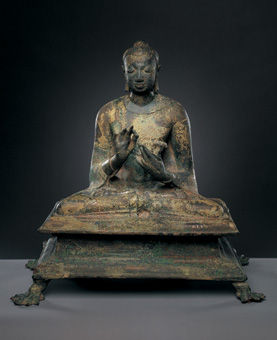
Buddha in the Gesture of Preaching. India, Gupta period, 6th century. Copper alloy with copper and silver inlay. Asia Society, New York: Mr. and Mrs. John D. Rockefeller 3rd Collection, 1979.7. © Asia Society, New York
5_Morandi_Rest_on_the_Flight_into_Egypt
Buddha Shakyamuni with Kneeling Worshippers. Myanmar/Burma, 14th - 15th century. Gilt copper alloy. Asia Society, New York: Mr. and Mrs. John D. Rockefeller 3rd Collection, 1979.91a–c. © Asia Society, New York
5
Buddha Shakyamuni, Tibet, 11th century, Copper alloy with copper overlay and inlays of silver. Asia Society, New York: Mr. and Mrs. John D. Rockefeller 3rd Collection, 1979.89 © Asia Society, New York
06_arcangelo_di_jacopo
Narrative Panels with Scenes from the Buddha's Life, Pakistan (ancient Gandhara), 2nd century. Gray schist. The Walters Art Museum, Baltimore, Maryland, Gift of John and Berthe Ford, 25.259. © The Walters Art Museum, Baltimore, Maryland
6
Buddha's First Sermon at Sarnath, Pakistan (ancient Gandhara), Kushan period, ca. 2nd century. Gray schist. The Metropolitan Museum of Art, Gift of Daniel Slott, 1980, 1980.527.4. © The Metropolitan Museum of Art
9_Habert_still_life
False Dormer Stele with Scene of Life of the Buddha, Pakistan (ancient Gandhara), Kushan period, 100–300. Schist. Asian Art Museum of San Francisco, The Avery Brundage Collection, B60S255. © Asian Art Museum Foundation, San Francisco. Used by permission
1
Portion of a Disassembled Stupa, India, Bihar, Bodh Gaya region, 9th century. Basalt. Philadelphia Museum of Art: Purchased with the George W. B. Taylor Fund, 1921, 1921-36-1. © Graydon Wood, courtesy Philadelphia Museum of Art
1
Goddess Palden Lhamo, Central Tibet, Densatil Monastery, 15th century. Gilt copper alloy, color, and semiprecious stones. Arthur M. Sackler Gallery, Smithsonian Institution, Washington, D.C.: Purchase Friends of Asian Arts in honor of the 10th Anniversary of the Arthur M. Sackler Gallery, S1997.27. © Arthur M. Sackler Gallery, Smithsonian Institution
1
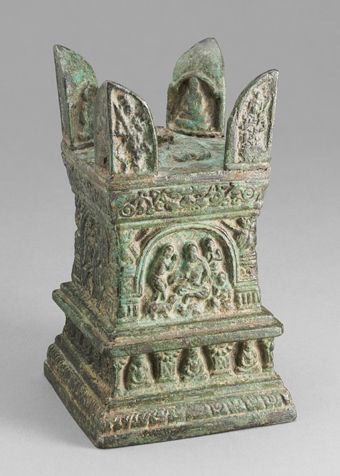
Reliquary in the Shape of a Stupa (Relic Mound), Pakistan (ancient Gandhara), Kushan period, ca. 4th–5th century. Bronze. The Metropolitan Museum of Art, Gift of Mr. and Mrs. Donald J. Bruckmann, 1985, 1985.387a,b. © The Metropolitan Museum of Art
1
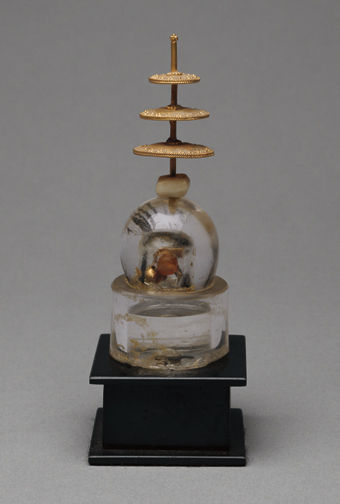
Stupa Reliquary, Sri Lanka, Anuradhapura period, ca. 200. Crystal and gold. The James W. and Marilynn Alsdorf Collection. © Michael Tropea
1
Miniature Stupa with Illustrations of Jataka Tales, China, Five Dynasties period, 955. Bronze. Harvard Art Museum, Arthur M. Sackler Museum, Gift of Nasli M. Heeramaneck, 1930.105. © Imaging Department © President and Fellows of Harvard College
1
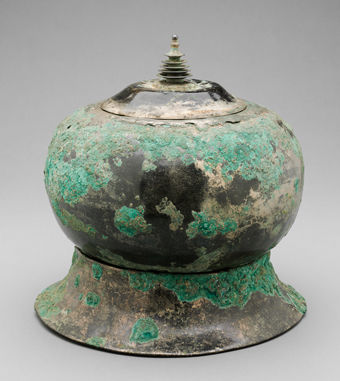
Covered Stupa-Form Buddhist Reliquary with Knob in the Shape of a Stupa Finial , Korea, Unified Silla period, 8th–9th century, Bronze. Harvard Art Museum, Arthur M. Sackler Museum, Anonymous Gift, 1944.57.29.A–C. © Imaging Department © President and Fellows of Harvard College
1
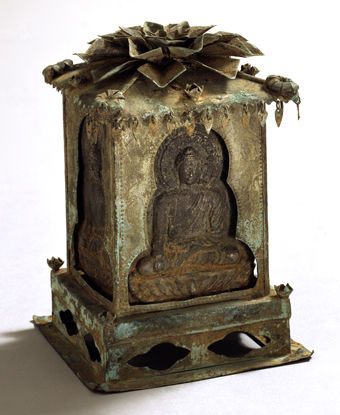
Reliquary, Korea, Unified Silla period, late 9th–early 10th century. Bronze and copper alloy. Royal Ontario Museum, Toronto, Dr. Herman Herzog Levy Bequest Fund, 992.124.1 © With permission of the Royal Ontario Museum © ROM. Photo: Brian Boyle
1
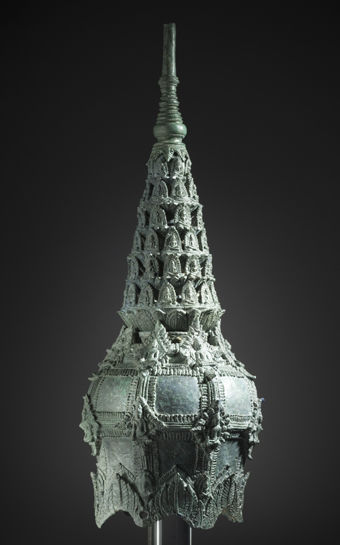
Model of a Stupa, Thailand or Cambodia, 12th–14th century. Copper alloy. Los Angeles County Museum of Art, Gift of Anna Bing Arnold, M.87.243 © 2009 Museum Associates/ Los Angeles County Museum of Art
Source: http://alaintruong.canalblog.com/tag/Korea